Skip to content

The Hybrid-Work Bag: Carrying Your Office Between Home and HQ
That sounds like a small shift. It isn't. A bag that commutes both ways, on a schedule that changes week to week, has to carry the half of your office that isn't nailed down. Most of the friction of hybrid work lives in that half: the charger left at home, the notebook left at the office, the bag slumped under a borrowed desk.
What hybrid work changed (Census)
The U.S. Census Bureau's commuting data puts the shift plainly. Its release Commuting in the United States: 2022 found that more than 15 percent of workers worked from home.
That figure counts people working from home, not people splitting the week, so it understates how many workers now move between two bases. But the direction is clear. For a large share of people with office jobs, the commute is no longer a daily constant. It is three days one week and two the next, and the kit has to keep up.
The practical consequence: you can no longer leave things at the office and trust they will be there, and you can no longer leave things at home and trust you won't need them. Something has to carry the overlap. That is the hybrid-work bag.
The two-charger rule
If you only adopt one habit from this post, make it this one: buy a second laptop charger and never take it out of the bag.
The charger is the item most often left behind, because on a home day it is plugged into the wall behind the desk. On an office day you discover it is still there. A second charger that lives permanently in the bag removes the decision entirely. The same goes for a phone cable.
The cost is one charger. The saving is every morning you would otherwise spend checking. And it only works if the bag has a fixed place for it: a tech compartment, or at minimum a pouch that never leaves. On the Alto Briefcase, that is the tech compartment for cords and chargers.

The commute kit vs the desk kit
Most hybrid workers carry too much because they never decided what lives where. Decide once:
| Item | Lives in the bag | Lives at home | Lives at the office |
|---|---|---|---|
| Laptop | ✓ (travels every day) | ||
| Laptop charger | ✓ (the second one) | ✓ (the first one) | |
| Phone cable and small power bank | ✓ | ||
| Notebook and two pens | ✓ | ||
| Current documents | ✓ (documents sleeve) | ||
| Headset or earbuds | ✓ | ||
| Second monitor, keyboard, mouse | ✓ | ✓ (if not a hot desk) | |
| Reference files, old notebooks | ✓ | ||
| Water bottle | ✓ | ||
| Spare tie or jacket | ✓ (if you have a locker) |
The rule underneath the table: anything you need on both kinds of day lives in the bag. Anything you need on only one kind of day lives at that location. Nothing commutes "just in case."
For where each of those bag items should sit, pocket by pocket, see how to organize a work bag. For the travel half of the week, what matters in a commuter bag covers the train, the car and the walk in.
A bag that stands up under a desk
Hybrid offices often mean hot desks: no drawer, no pedestal, sometimes not even a hook. The bag goes on the floor beside your chair for the day, and how it behaves there matters more than it used to.
A soft bag slumps. Everything inside slides to the bottom, the laptop leans against the cables, and you end up hunting through it on your knees. A structured bag that stands up on its own stays upright with its contents in place, so you unzip the top and the laptop comes out and goes back without unpacking the rest. The Alto stands on its own base, at 16.1 x 11 x 5.1 in, which also keeps its footprint narrow beside a shared desk.
This is one of the real differences between a briefcase and a backpack, and we laid out the honest trade-off in backpack vs briefcase for work. It is also part of why the boxy hard-shell case gave way to slimmer, softer-structured work bags, a shift we covered in the death of the boxy briefcase.
A word on carrying. How you carry weight over a commute is an ergonomics question, and we won't make health claims about any bag, ours included. OSHA's ergonomics pages are a sensible general starting point. What we can say is practical: carry less, by deciding what lives where, and the bag gets lighter whatever it is.
Packing list
A hybrid office-day checklist. Pack it the night before; the bag should be ready by the door.
- Laptop, charged, in its padded sleeve
- Second charger and phone cable (they never leave the bag)
- Small power bank in its pouch
- Notebook and two pens in their loops
- Today's documents in the documents sleeve
- Earbuds or headset
- Phone and badge in the quick-access pocket; keys on the key fob
- Water bottle, lid checked
- Anything that came home last office day and needs to go back
And the reverse check on a home day: is there anything in the bag that belongs at the office? Take it out now, or it commutes twice for nothing.
Once a week, usually Friday or Sunday evening, empty the bag completely. Receipts, dead pens, a second notebook you swore you'd use, the cable that came with something you no longer own: hybrid weeks accumulate clutter faster than five-day weeks did, because nothing ever gets unpacked at a desk you own. Ten minutes on an empty table and the bag is back to its baseline. If you want a fuller version of that routine, the Sunday-night reset is in our guide to organizing a work bag.
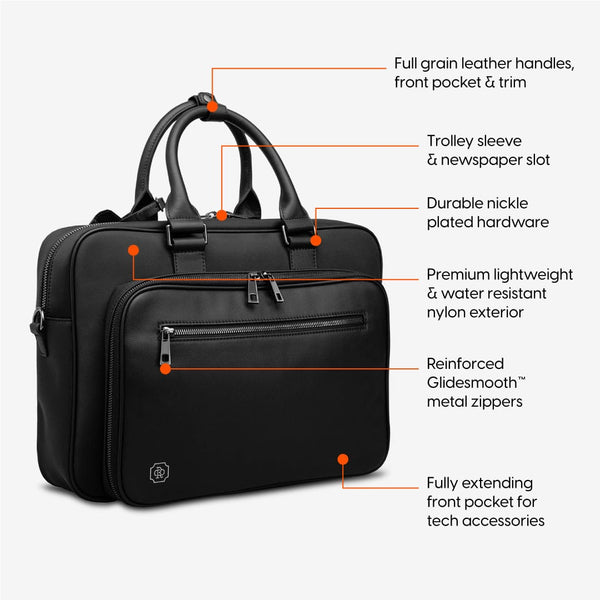
The Alto was laid out for this kind of week: a padded laptop sleeve of 15.3 x 10.2 in made to fit a 16-inch MacBook Pro, a tech compartment, a documents sleeve, a tablet pocket, a quick-access phone and passport pocket, 13 pockets across a dual compartment, an adjustable padded shoulder strap, and 3.3 lb empty. One customer summed up the aim:
"Great value and very well designed. I have found a place for everything in need and want to carry with me." — D., verified buyer, Jun 23 2023
Hybrid work moved the office into the bag. The bag might as well be organized like one.
Sources
- Commuting (Journey to Work), U.S. Census Bureau — "Commuting in the United States: 2022 … More than 15 percent of workers worked from home"
- Ergonomics, Occupational Safety and Health Administration — general ergonomics resource (no bag-specific claim)