Skip to content

The Death of the Boxy Briefcase: Why Modern Work Bags Had to Get Smarter, Not Just Slimmer
Somewhere in a closet right now, there's a briefcase shaped like a small filing cabinet. Rigid corners. One cavernous main compartment. A single latch that clicks shut like a courtroom gavel. It was built for a version of work that barely exists anymore — a world of fixed desks, paper memos, and a five-day commute to the same building.
That briefcase isn't coming back. And it shouldn't.

The boxy briefcase was designed for a job you don't have anymore
The classic hard-sided attaché made sense when "going to work" meant one location, one routine, and a short list of things you'd ever need to carry: a legal pad, a few folders, maybe a landline-era car phone if you were fancy. Structure and status mattered more than flexibility, because your day didn't require flexibility.
That's not the job anymore. Even employees with a "return to office" mandate on paper are living a hybrid reality — Robert Half's 2026 workforce research shows hybrid arrangements remain the dominant model across knowledge industries, with the office, the home office, the client site, and the airport lounge all showing up in the same week. A bag built for one static desk can't keep up with a job that now lives in four different places before Friday.

Slimmer was the industry's first answer. It wasn't the right one.
Give the industry credit: it noticed the boxy briefcase was dying. The response, for years, was to make bags thinner. Lighter laptops meant slimmer sleeves, and slimmer sleeves became the entire design brief — see the current wave of briefcases barely wider than a portfolio, a trend even mainstream buying guides now describe as the defining shift in men's bags this year.
But a slim silhouette solves a problem from 2015. It doesn't solve the problem you actually have now, which isn't "my bag is too bulky." It's "I own more useful, tiny objects than any professional in history — a laptop charger, a phone charger, a portable battery, wireless earbuds, a badge, a passport some weeks — and I still can't find my keys without unzipping three pockets." Shrinking the bag around all of that mess just makes the mess more cramped. It doesn't organize it.

Smart is a different design problem than slim
A genuinely modern work bag has to answer a harder question than "how thin can we make this?" It has to answer "how do we build a system for a job that changes shape every single day?" That means:
-
Dedicated zones, not just zippers. A padded compartment built specifically for a laptop, separate from a document sleeve, separate from a pocket sized for cables and a portable charger — not one open pit where everything migrates to the bottom.
-
Material that works both ways. Full-grain leather still signals the credibility a briefcase is supposed to carry into a room — we've written a full breakdown of what actually makes leather full-grain versus the marketing version of that term. But leather alone is heavy and fussy in daily use. The smarter move, as we've covered in our leather vs. nylon comparison, is pairing leather trim with water-resistant nylon twill: the credibility without the maintenance.
-
Built-in travel logic. A trolley sleeve that slides over a suitcase handle. A luggage tag. A shoulder strap that comes off when you don't need it. None of that is about looking slim — it's about a bag that doesn't need to be swapped out the moment a day trip turns into an overnight one.
-
Enough organization to actually find things. This is the part the slim-at-all-costs trend quietly sacrificed. A briefcase with real compartmentalization — think closer to a dozen-plus purpose-built pockets than three — is doing the job a boxy attaché never could: keeping a genuinely complicated daily kit fast to access, not just contained.
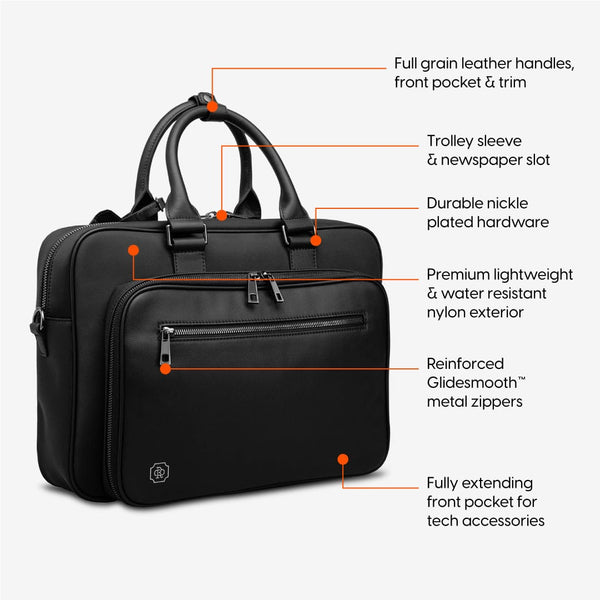
This is the thinking behind the Alto Briefcase: a dual-compartment built with 13 dedicated pockets, full-grain leather trim over water-resistant nylon, and travel details like a trolley sleeve built in from the start — not bolted on because a customer complained. It's not a slimmer version of the old briefcase. It's a different answer to a different question.

What to actually check before buying a work bag in 2026
If you're shopping for a briefcase right now, here's a shorter, sharper checklist than "does it look nice":
-
Does it separate tech from documents from small essentials — or is it one big pocket wearing a briefcase costume?
-
Can it survive both a boardroom and a layover? If your job has any travel to it at all, a bag that only performs at a desk is already outdated. (If travel is more than occasional, it's worth looking at a proper weekender built for exactly that overlap rather than forcing a briefcase to do a duffel's job.)
-
Is the material actually doing two jobs? Leather for durability and presence, technical fabric for weight and weather — not one material trying and failing to do both.
-
Would you still want to carry it in three years? Boxy briefcases didn't die because they looked bad. They died because they stopped matching how people actually work. Buy for the job you have, not the one from a decade ago.

For a deeper look at how briefcases stack up against the other daily-carry options out there, our guide to the different types of bags for men breaks down where each style earns its place — and where a smarter briefcase quietly replaces two or three of them at once.
The boxy briefcase had a good run. It just wasn't built for your run.